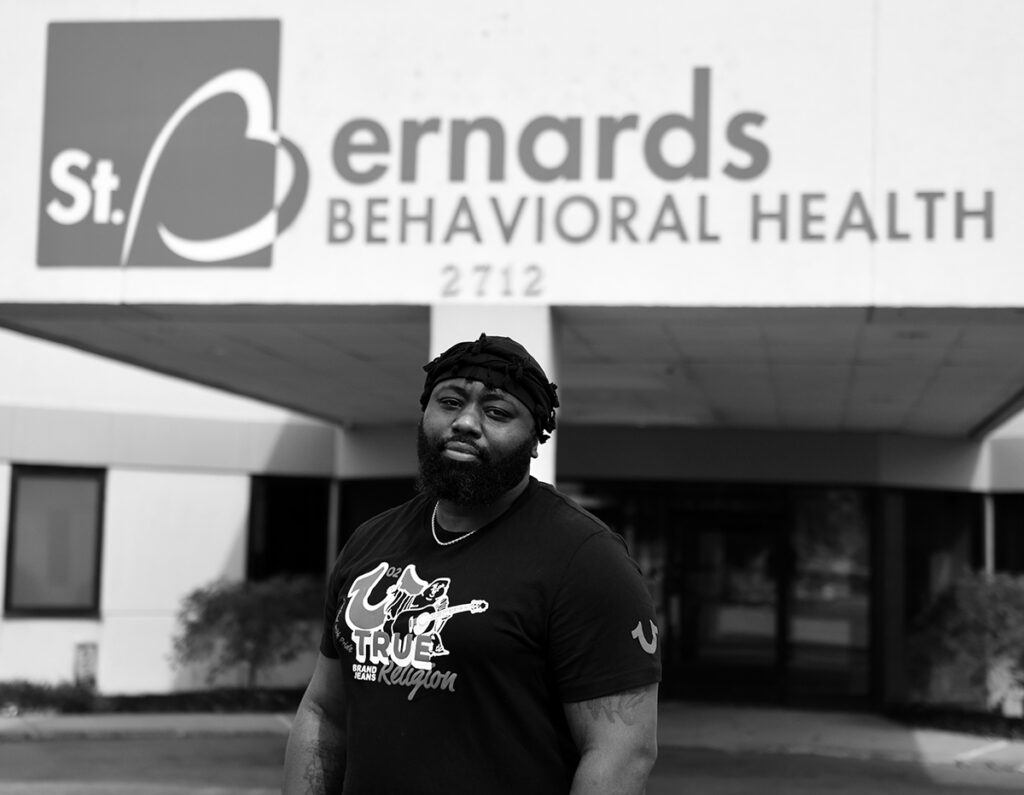
25 Weeks of Gratitude: St. Bernards Behavioral Health Center
Group therapy helped Donald Jones replace isolation and relapses with connection, accountability and hope.
For much of Donald Jones’ life, stress had an answer before he ever had words for it. In the home where he grew up in Pine Bluff, drinking was woven into ordinary life — family functions, hard days, heavy moments and whatever else needed numbing. When pressure built, alcohol was there. When life hurt, alcohol was there. By the time Donald was a teenager, he had absorbed the lesson without anyone needing to teach it directly: when stress comes, drink.
“I started drinking because my family, they drink,” Donald said.
That pattern followed him into adulthood. Donald, now 38, tried to get sober before. He was in recovery for a time through a previous program. Then his father became sick. The grief and fear came hard, and the old default returned.
“I started drinking again,” Donald said. “I had a relapse.”
A room built for recovery
When Donald entered addiction treatment through St. Bernards, he found something different: a place where recovery was not limited to brief individual appointments, but strengthened through intensive group therapy, peer support and continuing care.
A grant from the Blue & You Foundation for a Healthier Arkansas helped St. Bernards transform three individual therapy offices into one large group room for its intensive outpatient and partial hospitalization programs. Carmen Boyd, manager of addiction services and a licensed clinical social worker, said the space allows participants to receive more intensive addiction treatment than occasional individual therapy alone can provide.
“We only offer individual therapies once or twice per week,” Carmen said. “But with intensive outpatient, especially for addiction services, you need more intensive programming.”
Participants gather in the group room multiple days a week for several hours at a time. Carmen said the program serves people from the community as well as participants referred through court programs, including people facing the consequences of DWI or drug-related charges. The goal is not simply to complete a requirement, but to build sustained recovery and help people return to their communities with stability and support.
According to Carmen, participants in group therapy receive education about addiction, behavior and the brain. The focus is practical and personal: helping them understand how addiction affects the body, the mind and daily life.
But the power of the room is not only in what is taught. It is also in who is sitting there.
“They get to connect with other people who are going through a similar situation,” said Kelsey Henderson, a nurse practitioner and medication provider. “It’s not just medications, it’s not just therapy, it’s all of it together to be most successful.”
People who understand
For Donald, that peer connection mattered immediately. Recovery did not feel like sitting alone across from someone who could only listen from the outside. It felt like being surrounded by people who knew the weight of cravings, shame, loss and relapse because they had carried it too.
“Basically, just being around people that can relate to you is a big help,” Donald said. “It’s just trying to get through addiction together.”
He said it helped to hear others’ stories and to tell his own, because recovery can become harder when a person feels misunderstood.
“I want to be around people that can relate to me,” Donald said. “Hear their stories, let them hear my stories because they know what I’ve been through.”
Carmen said Donald benefited from the program “from start to finish.” He entered treatment through Craighead County STAR Court, a voluntary, post-adjudication program for sobriety, treatment, accountability, and recovery. He participated in intensive outpatient services, stepped down to individual therapy and continued with peer substance use disorder groups. Today, he is more than a year sober, gainfully employed and stably housed.
“This program gave him the support that he needed to reach or achieve sobriety and sustained recovery,” Carmen said.
Learning to reach out
Donald has been sober for more than 16 months – more than 500 days – and he still keeps in touch with peers from treatment. Sometimes they call him. Sometimes he calls them. Sometimes, when it is late and he does not want to bother anyone, he turns to a recovery app available around the clock. The important thing is that he no longer tries to carry the moment alone.
When someone reaches out, Donald said, the conversations are honest and simple.
“I’ll be like, I’m having a moment,” he said. “They need somebody to talk to, to vent about their day or their week or something that happened. You know, just someone to talk to for a while, to pray with a little bit, until the urge goes away.”
That kind of support is exactly what many people in recovery need.
“Being able to interact with peers and have that support is so important in recovery,” Kelsy said. “A lot of times, they’re having to change their support circle to get away from triggers.”
Isolation, she said, can be dangerous. Community can help replace it.
“Community engagement is huge because a lot of the substance use disorders occur in isolation,” Kelsey said.
“They treat you like family”
Donald gives the St. Bernards program the highest praise he can offer: “10 out of 10.”
What made the difference, he said, was not only the structure of the program but also the way people treated him within it.
“They treat you like family,” he said. “They aren’t trying to rush you off. They genuinely care.”
He said staff listened to him and made it clear he could come back when he needed support. That matters for someone who admits that asking for help does not come naturally. “I’m the one who doesn’t ask for help like that,” Donald said. “But if I’m calling, it’s something serious.”
Mitchell Nail, director of communications for St. Bernards Healthcare, said support from organizations such as the Blue & You Foundation helps sustain programs that can change the direction of a person’s life. “Without this kind of support, people like Mr. Jones might not be able to get the help they need,” Mitchell said.
A different default
Donald knows recovery is not maintained by pretending stress will disappear. Life still brings hard days. Urges still come. Memories still surface. But now, when pressure begins to build, he has a plan before he has a bottle. He can call a peer. He can send a text. He can reach out to Carmen or another staff member. He can talk, pray, wait and let the urge pass with someone else on the line.
Years ago, stress pointed him in the wrong direction.
Today, the default is different. Donald reaches for the phone. He calls someone who understands. He hears a familiar voice from the people who helped him recover. And in that connection, the old pattern loses its power.

In celebration of the 25th anniversary of the Blue & You Foundation, 25 Weeks of Gratitude spotlights 25 stories of Arkansans whose lives have been impacted by Foundation-funded work.
*The Blue & You Foundation was established in 2001 through an initial gift from Arkansas Blue Cross and Blue Shield. Since its inception, the Foundation’s financial base has grown through wise and prudent investment strategies. This has enabled the foundation to support its mission by making grants funded by the interest earned on those investments.